
Branding Trends in India: 10 Shifts, Real Examples and What Your Business Should Do Next
.png/v1/fill/w_320,h_320/file.jpg)
Indian brands have a new problem. Getting noticed is easier than ever, but being remembered, trusted, and chosen is becoming considerably harder.
A startup can launch a polished website in days. An established company can produce hundreds of social media creatives every month. AI tools can generate impressive-looking logos in seconds. Yet none of these advantages guarantees that customers will understand what makes a business different.
That is why branding trends in India are moving beyond attractive logos and catchy advertisements. Businesses are paying closer attention to customer experience, regional relevance, consistent brand identity, and the relationship between branding and actual sales.
The challenge is knowing which trends deserve investment and which are temporary design fashions.
Should your business embrace AI-generated creative work? Is minimalist branding still effective? Does regional storytelling matter when selling nationwide? And how do you modernise an existing identity without confusing loyal customers?
In this guide, we examine ten developments changing Indian branding, explain how businesses can apply them, and share practical ways to build a brand that customers recognise and remember.
Key Takeaways: What Is Changing in Indian Branding?
Brand identity is becoming a complete system, covering websites, packaging, social media, customer service and brand voice.
AI in branding design is accelerating research and creative exploration, but human judgement remains essential for differentiation.
Digital-first branding India strategies increasingly prioritise mobile experiences, marketplace visibility and short-form content.
Regional storytelling is becoming more important as brands target consumers beyond major metropolitan cities.
Minimal brand identity systems remain valuable when simplicity improves clarity rather than eliminating personality.
Customer trust, consistency, and experience are becoming central to brand differentiation.
Modern branding strategies need measurable commercial objectives instead of focusing entirely on visual appeal.
What Are the Biggest Branding Trends in India?
The biggest branding trends in India include AI-assisted design, digital-first brand identities, regional storytelling, minimalist visual systems, creator-led communities, purpose-backed communication, personalised experiences, motion branding, customer-driven strategy and consistent omnichannel experiences. Together, these developments are changing how Indian businesses build recognition, credibility and long-term customer relationships.
The important distinction is that not every trend will benefit every business.
A premium jewellery company, a regional food manufacturer and a technology startup may all need modern branding, but their customers make purchasing decisions differently.
A successful strategy begins by understanding the audience, competitive environment, and business objective before selecting any creative direction.
Why Is Branding Changing So Quickly in India?
India's digital economy has created new opportunities for companies that previously depended on physical visibility, distributors, or traditional advertising.
According to the IAMAI–Kantar Internet in India 2025 report, released in January 2026, India had approximately 958 million active internet users in 2025.
That expansion is reshaping where consumers discover, evaluate, and purchase products.
A customer might first discover a skincare brand through Instagram, compare products on a marketplace, check independent reviews, search the company's name, and finally purchase through its website.
Every stage influences perception.
If the Instagram profile communicates premium quality but the website appears unreliable, the brand loses consistency. If the packaging makes ambitious claims that customer reviews contradict, the brand loses credibility.
This is why branding can no longer be separated from digital experience, content strategy and customer satisfaction.
The Indian market is also becoming less dependent on metro-centric assumptions. IBEF's reporting on the D2C sector highlights the growing role of Tier 2 and Tier 3 cities in driving new orders.
For businesses, the lesson is clear: A recognisable brand identity must remain consistent while communicating in ways that genuinely connect with different audiences.
1. AI in Branding Design Is Changing How Brands Are Created
Artificial intelligence is making the early stages of branding faster and more accessible.
Design teams can use AI-assisted tools to explore creative directions, prepare concept variations, organise research, and test different visual approaches before committing to a final identity.
However, quicker production does not automatically produce a stronger brand.
How is AI changing the branding process?
AI in branding design helps businesses accelerate research, visual experimentation, content production, and creative testing. It can generate multiple design concepts rapidly, but effective branding still requires human expertise to assess originality, audience relevance, cultural sensitivity, usability, and alignment with business strategy.
AI can assist with:
Organising competitor and audience research.
Exploring logo concepts and visual directions.
Creating preliminary packaging mockups.
Developing campaign ideas and messaging alternatives.
Adapting approved creative assets for different formats.
Identifying recurring themes in customer feedback.
Consider a new organic food brand entering the Indian market.
An AI tool may quickly generate earthy colour palettes, leaf-based symbols, and minimalist packaging concepts. The problem is that competing brands can generate nearly identical ideas.
The real branding decision is whether those visual elements communicate a meaningful advantage.
Does the company offer traceable sourcing? Does it serve working families looking for convenience? Is it built around regional ingredients or a particular nutritional requirement?
Those answers should drive the brand identity.
Expert Insight: Use AI for exploration, not brand ownership
Our recommended approach is to establish the positioning statement, target customer, and brand personality before exploring AI-generated creative options.
A practical AI-assisted branding workflow
Define the business problem and ideal customer.
Research competitor positioning and visual conventions.
Develop a distinctive brand promise.
Use AI to explore relevant design directions.
Refine concepts through professional design judgement.
Test shortlisted identities with actual target customers.
Complete originality, accessibility and trademark checks before launch.
Tools such as Adobe Firefly, Canva and generative design platforms can support exploration. They should not substitute for strategic research or appropriate intellectual-property review.
Our recommendation: Invest in the thinking that makes the design distinctive, not simply the technology that produces the design faster.
2. Digital-First Branding Is Becoming the Default
Previously, many businesses developed their identities around physical applications such as signboards, brochures, and printed advertisements.
Today, customers may encounter a brand for the first time through a six-inch mobile screen.
That changes the design brief.
What is digital-first branding?
Digital-first branding is the practice of building a brand identity around digital customer interactions from the beginning. It prioritises mobile readability, responsive visual systems, clear messaging, accessible interfaces and consistent experiences across websites, social platforms, search results, apps and online marketplaces.
For many businesses, digital-first branding in India now means preparing an identity that performs consistently across both online and offline channels.
A logo that looks impressive on a large presentation slide might become unreadable as an Instagram profile image.
Similarly, an elaborate brand story may work beautifully in a printed brochure but fail to communicate anything meaningful in the first few seconds of a mobile visit.
Digital-ready brands consider these details during the initial design process.
What should a digital-first identity include?
A functional digital-first branding system should cover responsive logo variations, mobile-friendly typography, consistent colour usage, adaptable social templates, accessible website elements, and clear messaging across customer touchpoints.
It should also define how the brand appears in marketplace thumbnails, search listings, customer emails and short-form videos.
Example: A regional clothing retailer expanding into nationwide e-commerce may need simplified product imagery, recognisable social-media design, clear delivery information and consistent product descriptions.
The goal is not simply to look fashionable online.
It is to make the company immediately recognisable while reducing friction between discovery and purchase.
For businesses planning a digital transformation, our website design and development services can help connect brand identity with the customer experience.
3. Minimal Brand Identity Systems Are Replacing Complicated Visual Designs
Minimalism remains relevant in Indian branding, but businesses are becoming more thoughtful about how they apply it.
Simply removing decorative elements is not the same as developing a strong minimalist identity.
Why are brands adopting minimalist identities?
Minimalist identities use deliberate choices in typography, colour, composition and visual hierarchy to communicate clearly across multiple platforms. Their main advantage is flexibility. When executed strategically, simple design systems can make brands easier to recognise, reproduce and maintain without sacrificing their personality.
A company does not necessarily need ten colours, several font families and elaborate graphics to look established.
In many situations, one distinctive typeface, a carefully selected colour palette and a recognisable visual element can create a coherent identity.
However, extreme minimalism has its own risk.
When every technology startup uses similar geometric fonts and neutral colours, consumers may struggle to distinguish one company from another.
Minimalism versus generic branding
Effective minimal branding | Generic minimal branding |
Reflects a distinctive brand personality | Copies popular design conventions |
Improves communication clarity | Removes meaningful visual character |
Works across print and digital formats | Looks good only in mockups |
Uses recognisable visual elements | Resembles competing brands |
Supports long-term consistency | Depends on a temporary aesthetic |
When should you choose a minimalist identity?
A minimalist approach can be useful for professional services, technology businesses, premium consumer products, and companies operating across many channels.
However, highly expressive visual identities may work better for entertainment, children's products, or culturally rich lifestyle categories.
The correct decision depends on positioning and customer expectations.
Our preference is to build minimal brand identity systems around purpose rather than fashion.
The strongest result is not the simplest-looking design. It is the simplest design that still communicates everything important about the brand.
4. Regional Storytelling Is Giving Indian Brands a Competitive Advantage
India cannot be treated as one uniform consumer market.
Language, buying habits, cultural references, celebrations, and perceptions of value can vary significantly between regions.
A campaign developed for urban Bengaluru may not resonate in exactly the same way with customers in Coimbatore, Kolkata, or Jaipur.
That does not mean a business needs completely separate identities for every city.
It means the brand needs to understand where cultural differences influence customer decisions.
Why is regional branding growing in India?
Regional branding is gaining importance because consumers want communication that reflects their language, cultural context, and everyday experiences. Effective localisation goes beyond translating advertisements. It may involve adapting stories, product presentation, design references and customer experiences while preserving the brand's central identity.
At ETBrandEquity's July 2026 Brand World Summit, industry speakers emphasised that businesses seeking growth in smaller Indian markets need to create communication based on local realities, rather than merely translate national campaigns.
For example, a packaged food company entering Tamil Nadu could benefit from understanding local food practices, retail behaviours and cultural preferences before designing its communication.
The same company entering Maharashtra might identify different consumer expectations.
How can businesses introduce regional relevance?
Start with local customer research.
Review language preferences, customer enquiries, commonly used expressions, popular retail channels, and purchasing barriers.
Then adapt elements such as campaign copy, product photography, regional creator collaborations and customer-support communication.
The visual identity should remain recognisable even when the message changes.
Expert Insight: Cultural understanding should influence the creative brief before design begins. Translating a completed English campaign into a regional language is not equivalent to creating a culturally relevant campaign.
For Indian businesses targeting multiple states, regional relevance is one of the most practical consumer-driven branding trends to evaluate.
5. Authentic Brand Purpose Is Becoming More Important Than Promotional Claims
Consumers encounter ambitious brand promises every day.
Companies describe themselves as sustainable, innovative, ethical, customer-first, and socially responsible.
The difficulty is that these words mean little without supporting evidence.
What is purpose-driven branding?
Purpose-driven branding connects a company's values and commitments with its products, operations and customer experience. It works best when promises are supported by verifiable actions. A meaningful brand purpose should explain what the business stands for without relying on exaggerated environmental, social, or ethical claims.
An apparel manufacturer promoting responsible production should be prepared to substantiate relevant sourcing or manufacturing statements.
A personal-care company advertising specific product benefits needs appropriate supporting evidence.
Customers should not have to accept vague promises simply because the packaging looks trustworthy.
Building credibility through real actions
For an Indian business developing purpose-led branding, we recommend focusing on:
Clearly explained sourcing and production practices.
Accurate descriptions of product benefits.
Accessible customer-service information.
Relevant third-party certifications where applicable.
Transparent policies and verifiable claims.
Consistent behaviour across advertising and operations.
Consider a small skincare company.
Instead of using an unsupported phrase such as "India's most sustainable skincare brand", it could communicate specific, verifiable packaging or ingredient-sourcing practices.
That information is more useful to customers and easier to evaluate.
A good brand promise should become more believable when the customer investigates it.
6. Customer-Led Branding Is Replacing Assumption-Based Campaigns
Some businesses still develop identities based primarily on what founders or management teams personally prefer.
The founder likes blue, so the brand becomes blue. A competitor uses a luxury visual style, so the company copies it. A new typography trend appears, and the entire website is redesigned.
None of these decisions necessarily reflects customer expectations.
What is customer-driven branding?
Customer-driven branding uses audience research, customer feedback, behavioural insights and market testing to inform brand positioning, design and communication. Instead of making decisions entirely from internal preferences, businesses identify what customers value, what prevents purchases and which experiences create trust.
This does not mean customers should be asked to design the brand.
It means their needs should influence the decisions made by professional strategists and designers.
Turning customer insight into a brand strategy
Imagine a growing healthcare business that wants to appear more premium.
A visually elaborate redesign may seem like the obvious solution.
However, customer research might reveal that the primary concerns are treatment clarity, doctor qualifications, transparent information, and appointment convenience.
In that situation, a trustworthy, accessible website and clear communication may contribute more to the brand experience than expensive decorative design.
We recommend using customer interviews, review analysis, website behaviour, and sales-team feedback before beginning a major branding exercise.
Modern branding strategies become more effective when they address an identifiable business or customer problem.
7. Creator-Led Branding Is Making Brand Communication More Human
India's influencer and creator economy has changed how people encounter businesses.
Instead of discovering products only through traditional advertisements, consumers regularly encounter recommendations, demonstrations, and personal experiences shared by online creators.
But reach alone does not guarantee credibility.
How does creator-led branding work?
Creator-led branding involves collaborating with relevant content creators, industry specialists, or community voices to communicate a brand's value through useful and relatable content. The most suitable partners are not always those with the largest audiences. Relevance, audience alignment, credibility and content quality are often more important.
A national celebrity may generate attention for a product launch.
A knowledgeable regional creator, meanwhile, may be better suited to demonstrating a niche product to a specific audience.
For example, a kitchenware company could collaborate with cooking creators who regularly explain practical cooking techniques.
A software business might achieve more useful engagement through industry educators who understand its customers' professional challenges.
Choosing the right creator partnerships
Businesses should evaluate audience demographics, engagement quality, content authenticity, brand suitability, and previous commercial partnerships.
They should also establish clear expectations around sponsored-content disclosure and approval of factual claims.
Most importantly, creator activity should reinforce the brand's positioning.
If a product is positioned around durability and practical value, promotional collaborations should demonstrate those qualities rather than focusing only on entertainment.
The goal is to develop credible associations that survive beyond a single campaign.
8. Motion Branding Is Helping Brands Become Recognisable in Short-Form Content
Static logos are still important.
However, video-first platforms have created additional opportunities for brands to express their identities through movement.
Motion branding involves developing repeatable visual behaviours such as animated logos, transitions, kinetic typography and other recognisable movement patterns.
Why does motion branding matter?
Motion branding helps businesses create a recognisable visual presence in videos, digital advertisements, app interfaces and social content. Consistent animation styles can reinforce identity across changing formats, provided the movement supports clarity, accessibility and brand personality rather than distracting from the message.
A restaurant chain, for example, might use a recognisable animated transition between product shots.
An educational company could develop consistent opening animations for explanatory videos.
A technology business might use subtle interface motion to make digital interactions feel coherent.
How much motion is appropriate?
Not every brand needs elaborate animation.
A minimal logo reveal and consistent transition system may be enough for a professional-services business.
Entertainment and youth-oriented brands may benefit from a more expressive visual language.
What should a motion branding guide specify?
It should define animation duration, movement style, logo behaviour, transition rules and applications across digital platforms.
It should also account for reduced-motion accessibility preferences.
Our recommendation: Create a recognisable motion style rather than producing different animations for every campaign.
9. Personalised Branding Is Moving Beyond Using Customers' Names
Personalisation is often misunderstood as adding a customer's first name to an email or showing previously viewed products.
Effective personalisation goes further.
It considers what information, support, or experience is relevant to a particular customer at a particular stage of their journey.
What is personalised branding?
Personalised branding adapts communication and customer experiences to relevant needs, preferences or contexts while maintaining a consistent brand identity. It may involve targeted content, appropriate product recommendations, language preferences or different onboarding journeys. Effective personalisation respects privacy and avoids intrusive data practices.
For example, a financial-services company might create different educational resources for first-time investors and experienced customers.
A home-interiors company could provide distinct content for new homeowners, renovation customers and commercial property developers.
The central brand promise remains the same, but the information becomes more useful.
Personalisation without inconsistency
Businesses should define which elements can change and which must remain constant.
Product recommendations, content formats and communication language may vary.
Core messaging, visual principles, service standards and brand values should remain recognisable.
Personalisation works when customers feel understood, not when every interaction appears to come from a completely different company.
10. Brands Are Competing on the Complete Customer Experience
One of the most commercially important developments is that branding is becoming inseparable from the customer experience.
A polished logo cannot compensate for confusing product information.
Premium packaging cannot repair repeated service failures.
A compelling advertisement cannot create loyalty when the actual product disappoints customers.
What is experience-led branding?
Experience-led branding builds brand perception through the quality and consistency of customer interactions. It connects visual identity, messaging, product experience, purchasing processes, support, and after-sales communication. Its objective is to make the brand promise credible through repeated real-world experiences.
Consider a consumer electronics business.
Customers may interact with its social media content, website, product packaging, installation instructions, support team, and warranty process.
Each interaction contributes to the same brand perception.
A good branding strategy makes these experiences feel connected.
Why consistency matters
Imagine receiving a premium-looking product in damaged packaging, followed by an unclear warranty response.
The initial design investment becomes less valuable because the customer's actual experience contradicts the brand promise.
Businesses should therefore evaluate branding across the complete customer journey.
This includes what happens before a sale, during the purchase, and after delivery.
The brands most likely to build lasting customer relationships are those that consistently deliver what their identities promise.
Traditional Branding vs Modern Branding Strategies in India
The shift towards contemporary branding is not about abandoning traditional channels. It is about integrating them into a more connected, measurable system.
Branding factor | Traditional approach | Modern approach |
Brand identity | Fixed logo and visual guidelines | Flexible identity system |
Audience targeting | Broad demographic groups | Research-led customer segments |
Creative production | Mainly manual processes | Human creativity supported by AI |
Communication | One-way advertising | Interactive, community-led engagement |
Regional marketing | National creative adapted locally | Cultural insight informs the original brief |
Customer experience | Separate from brand design | Integrated into brand strategy |
Measurement | Reach and general awareness | Awareness, consideration, conversion and loyalty |
Brand management | Occasional redesigns | Continuous improvement within clear guidelines |
The right approach is not necessarily to replace every traditional activity.
For an established manufacturer, printed catalogues, distributor relationships and trade exhibitions may remain important. Modern branding should make these channels consistent with the company's website, digital content and sales communication.
How Are Indian Brands Applying These Trends in Practice?
Looking at recognisable Indian brands helps demonstrate how brand strategy extends beyond visual design.
boAt: Youth-focused brand personality
boAt provides an example of an identity associated with music, lifestyle and youth culture. Its visual personality and product communication illustrate how a consumer-electronics brand can build differentiation beyond technical specifications.
Paper Boat: Culture-led storytelling
Paper Boat is a useful reference for turning familiar Indian beverages and nostalgic associations into a distinctive packaging and storytelling approach. The lesson is that cultural familiarity can become a strategic asset when connected with a genuine product proposition.
Nykaa: Connected retail experiences
Nykaa illustrates how a recognisable brand can operate across digital shopping, content, product discovery and physical retail. Consistency across these touchpoints helps customers navigate a more complex purchasing journey.
These are illustrative brand-strategy examples, not independently measured case studies of the companies' 2026 campaign performance.
For smaller businesses, the lesson is not to copy the scale or aesthetics of larger companies. It is to identify the principle behind the approach and apply it within an appropriate budget.
How to Choose the Right Branding Trend for Your Business
Adopting every emerging trend is neither affordable nor necessary.
The better approach is to evaluate whether a trend addresses an existing weakness in the brand.
A practical branding decision framework
We recommend examining four questions before committing to a new direction.
1. Does the trend match your customer?
A regional-language strategy could be valuable for a consumer brand targeting multiple Indian states.
It may be less relevant to a specialist B2B organisation serving a narrow international audience.
Start with audience behaviour rather than market excitement.
2. Does it address an identifiable business problem?
If customers do not understand your offering, clearer positioning may be more valuable than motion graphics.
If people recognise the brand but do not trust the website, customer experience and credibility may deserve priority.
3. Can it work consistently across channels?
A highly decorative identity might look impressive in advertisements but become difficult to maintain across product labels and mobile interfaces.
Consider usability before selecting a creative trend.
4. Can you measure whether it helped?
Branding does not always produce immediate revenue attribution.
However, businesses can monitor useful indicators such as branded search demand, customer recognition, qualified enquiries, and repeat purchases.
Branding priorities by business type
Business type | Recommended priorities |
Early-stage startup | Positioning, distinctive identity, digital-first guidelines |
D2C product company | Packaging, marketplace visuals, creator content, customer trust |
B2B manufacturer | Professional identity, clear value proposition, sales consistency |
Healthcare provider | Credibility, accessibility, accurate information, experience |
Regional retail business | Local relevance, recognisable design, digital discoverability |
Established company | Brand audit, selective modernisation, omnichannel consistency |
How Much Does Professional Branding Cost in India?
Professional branding costs in India vary according to the project scope, research depth, creative deliverables, agency expertise, and implementation requirements.
A logo-only assignment may involve substantially less work than a complete brand strategy and identity programme.
Indicative branding budget ranges
The following amounts are illustrative planning ranges, not verified average Indian market prices or a quotation from our team.
Project scope | Illustrative budget |
Basic logo and starter identity | ₹15,000–₹50,000 |
Small-business identity system | ₹50,000–₹1.5 lakh |
Comprehensive brand identity | ₹1.5–₹5 lakh |
Research-led brand strategy and identity | ₹3–₹10 lakh |
Complex rebranding and multi-channel rollout | ₹10 lakh+ |
Actual proposals may fall outside these ranges, especially for highly specialised, enterprise-scale or multi-market projects.
What affects branding prices?
Five factors generally have the greatest influence:
Research requirements: Customer interviews, competitor audits and positioning workshops increase the depth of work.
Design deliverables: Logos, packaging, digital templates, typography systems and brand guidelines require different levels of production.
Business complexity: A single-product startup has different requirements from a company managing several product categories.
Implementation support: Website updates, packaging production and campaign launches may be separate project components.
Testing and revisions: Structured customer validation, stakeholder reviews, and additional concept development affect the schedule and cost.
Businesses should compare proposals on deliverables, intellectual-property terms, revision policies, research quality, and implementation support rather than price alone.
DIY Branding vs Hiring a Professional Branding Agency
DIY branding can be practical for a business that needs basic launch materials and has a limited budget.
However, professional support becomes more valuable when positioning, differentiation, and multi-channel consistency are commercially important.
DIY branding | Professional branding agency |
Lower initial investment | Higher initial investment |
Useful for basic visual experiments | Useful for research-led brand decisions |
Greater reliance on internal judgement | Access to external strategic and design expertise |
May be difficult to standardise | Can provide documented identity systems |
Appropriate for simple early-stage needs | Suitable for launches, expansion and rebranding |
When should you hire a branding agency?
Consider professional support when customers confuse your business with competitors, your visual identity varies across channels, you are entering a new market, or the company has outgrown its original positioning.
Hiring an agency can also be useful when branding decisions involve multiple stakeholders or expensive packaging and website changes.
The strongest agency relationship should begin with understanding the problem, not selling a predetermined logo package.
Our Approach to Building Brands for Indian Businesses
A business investing in branding should expect more than attractive design presentations.
At BigBang, we approach branding as a connection between business strategy, identity, and customer experience.
Our publicly documented services cover brand strategy, logo and identity design, promotional design, packaging and labels, website development and digital marketing. We work from Coimbatore, with branding services offered to businesses across India.
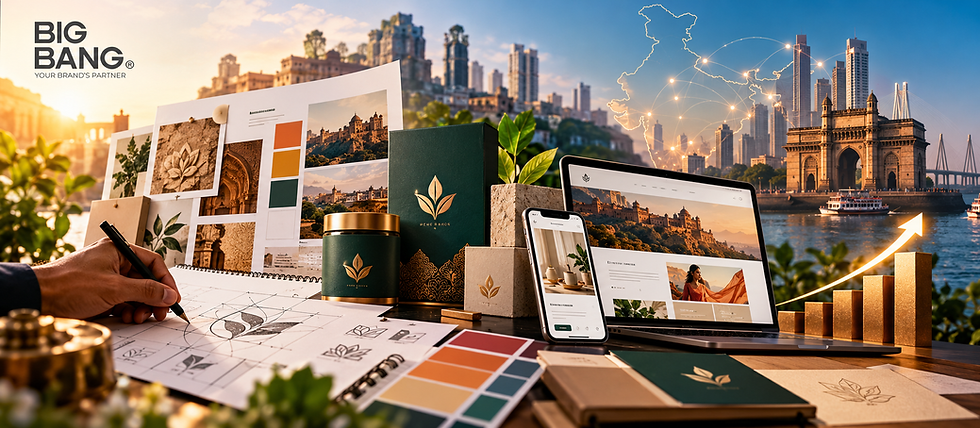
How we help businesses approach brand development
Our service offering supports a connected approach to branding, which may include:
Brand discovery and positioning: Understanding the product, audience, competitive environment, and intended value proposition.
Creative identity development: Designing visual elements that communicate the company's personality and positioning.
Packaging and communication design: Creating consistent customer-facing materials across relevant applications.
Digital brand experience: Connecting the identity with the website and other online touchpoints.
Implementation planning: Establishing practical guidance for maintaining consistency as the company develops.
The exact activities and deliverables should be confirmed within the agreed project scope.
A practical example from our portfolio
Our publicly documented work for Legacy, an apparel brand, included brand strategy, identity development, packaging, marketing collateral, and website design and development.
The objective was to communicate heritage, resilience, and timeless quality through a cohesive brand system.
The published case study describes the creation of coordinated visual and marketing guidelines supporting the brand's positioning. It does not provide numerical revenue or conversion results, so we do not present unverified performance claims.
This illustrates an important point: brand development works best when the visual identity is connected to the product's story and customer-facing experience.
Businesses exploring a new identity can learn more about our branding and brand identity services in India.
Common Branding Mistakes Indian Businesses Should Avoid
Mistake 1: Copying a successful competitor
A visual identity that works for one company may not fit another company's audience or positioning.
Better approach: Analyse competitors to identify opportunities for differentiation, not designs to reproduce.
Mistake 2: Treating branding as only logo design
A logo is a useful identity asset, but it cannot independently communicate every aspect of a business.
Better approach: Develop a consistent system covering messaging, visual identity, customer experience, and communication.
Mistake 3: Following trends without considering the audience
An expressive, youthful design may be suitable for a lifestyle brand but inappropriate for a specialist professional service.
Better approach: Evaluate every trend against customer expectations and business objectives.
Mistake 4: Using AI-generated visuals without reviewing originality
AI-generated creative outputs may lack distinctiveness or introduce intellectual-property concerns.
Better approach: Apply human creative direction and appropriate clearance checks before adopting important brand assets.
Mistake 5: Ignoring smaller Indian markets
A single communication approach may overlook relevant cultural and language differences.
Better approach: Conduct regional research and adapt communication where necessary.
Mistake 6: Rebranding without a clear business objective
An unnecessary identity change can consume resources and disrupt existing recognition.
Better approach: Determine whether the actual problem concerns positioning, visual design, customer experience, or service delivery before proceeding.
A 90-Day Roadmap to Modernise Your Branding
Businesses do not need to implement every modern branding trend simultaneously.
A phased approach can make decision-making more manageable.
Days 1–30: Research and diagnosis
Review existing identity assets, competitor positioning, customer feedback, branded search performance, and conversion obstacles. Identify the three most significant weaknesses affecting brand perception.
Days 31–60: Strategy and creative development
Define the value proposition, core messaging, brand personality, and visual direction. Create initial concepts and test them with relevant users before final approval.
Days 61–90: Launch and measurement
Update priority digital and physical assets, introduce consistent templates, train relevant teams, and establish baseline performance indicators. Plan additional improvements based on evidence.
These phases are a planning framework rather than a guaranteed project timeline. Larger rebranding exercises may require considerably longer.
Which branding KPIs should you track?
A meaningful scorecard can include branded search impressions, direct and returning visitors, unaided brand awareness, qualified enquiries, website conversion rate, customer sentiment and repeat-purchase behaviour.
Avoid assuming that every improvement in these metrics results directly from branding. Advertising activity, pricing, seasonality and product changes can also affect performance.
The Next Frontier: Branding for AI Search and Generative Discovery
Brand identity increasingly exists in environments where customers may not visit the company's website first.
A potential customer could ask ChatGPT, Gemini, Perplexity, Claude, or another AI-enabled service to explain product categories or identify businesses worth considering.
This introduces another responsibility for modern brand strategy.
How should brands prepare for AI-assisted discovery?
Brands can improve their readiness for AI-assisted discovery by maintaining accurate, consistent company information and publishing useful, verifiable content. Clear service descriptions, identifiable expertise, documented case studies, trustworthy external references, and technically accessible websites make business information easier to understand and evaluate.
This does not guarantee recommendations or citations by AI systems.
However, it gives customers and information-retrieval systems clearer evidence of what the business offers.
For an Indian branding agency, this means consistently explaining its services, industry expertise, location, and project work across relevant digital properties.
For a product company, it means publishing accurate product specifications, policies, comparison information, and customer guidance.
AI search visibility should support a credible brand strategy, not replace it.
Expert Insight: A distinctive brand must be understandable both to human customers and to the systems they use to research purchasing decisions.
Final Thoughts: Indian Branding Is Moving From Appearance to Meaning
The most important branding development in India is not a particular logo style, colour palette or software tool.
It is the growing expectation that brands should communicate clearly, behave consistently and offer customers a convincing reason to choose them.
AI can make creative production faster. Minimalist design can improve clarity. Regional storytelling can strengthen relevance. Creator partnerships can introduce a business to new communities.
But none of those approaches replaces a clear brand position or a dependable customer experience.
For Indian startups and established businesses alike, the best investment is not necessarily the trend receiving the most attention.
It is the strategy that helps the company become easier to recognise, easier to understand, and more credible to its intended customers.
Ready to Build a Brand That Stands Apart?
If your current brand identity no longer reflects your business ambitions, or you are preparing to launch a new product, our team can help you explore the right creative direction.
We bring together brand strategy, identity design, packaging, and digital experience services to support businesses at different stages of development.
Explore our branding services, discuss your requirements, and request a project-specific proposal.
Discuss your branding project with us
Brand strategy • Visual identity • Packaging • Digital branding
+91 85751 81751
Coimbatore, Tamil Nadu, India
Explore Our Branding Services
Frequently Asked Questions
1. What are the latest branding trends in India?
The leading branding trends in India include AI-assisted design, minimalist identity systems, regional storytelling, digital-first experiences, creator-led marketing, and customer-focused brand strategies. Businesses are also investing in flexible visual identities and consistent communication across platforms. The right trend depends on the company's audience, positioning, industry and commercial objectives.
2. How is AI changing branding design for Indian businesses?
AI helps Indian businesses explore design concepts, organise research, develop creative alternatives, and produce marketing assets more efficiently. However, AI-generated content still needs professional evaluation for originality, cultural relevance, and accuracy. Combining AI-assisted production with human strategy is generally more useful than relying on automated design outputs alone.
3. Why is digital-first branding important for startups in India?
Digital-first branding helps startups communicate consistently across websites, mobile interfaces, social media, and online marketplaces. Since customers frequently discover and evaluate businesses digitally, an adaptable visual identity and clear messaging are essential. A strong digital presence can support brand recognition, trust, and more convenient purchasing experiences.
4. Are minimalist branding designs suitable for every industry?
Minimalist branding can be effective for technology, professional services and premium consumer businesses when it improves clarity and recognition. However, industries requiring expressive visual communication may benefit from more distinctive design approaches. The ideal identity should reflect customer expectations, brand personality, product positioning and practical usage requirements.
5. How much does branding cost for a small business in India?
Branding costs depend on the scope, research requirements and creative deliverables. Basic identity work may cost tens of thousands of rupees, while comprehensive research-led programmes can require several lakhs. Businesses should request itemised proposals covering strategy, logo design, guidelines, revisions and implementation before comparing agencies or finalising budgets.
6. What is the difference between brand identity and brand strategy?
Brand strategy defines how a business wants to be positioned, which customers it serves, and why those customers should choose it. Brand identity expresses that strategy through logos, typography, colours, messaging and other recognisable elements. Strong branding combines both, ensuring creative decisions support meaningful business objectives.
7. When should an Indian business consider professional rebranding?
A business should consider rebranding when its positioning has changed, customer expectations have evolved, or its existing identity no longer communicates its value effectively. Rebranding may also support expansion into new markets. Before redesigning, companies should assess existing brand recognition, customer feedback, business objectives, and implementation costs.


Comments